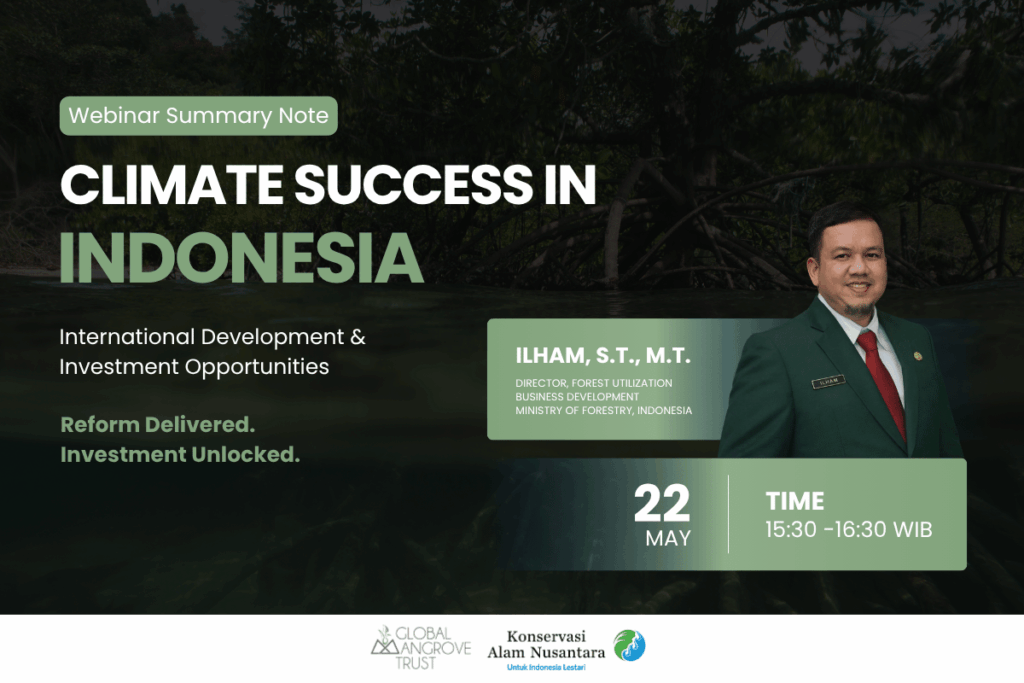
Global Mangrove Trust (GMT), together with the Ministry of Forestry Indonesia and YKAN, convened an international webinar focused on Indonesia’s evolving carbon market framework, social forestry implementation, and emerging opportunities around blue carbon and nature-based solutions. The session brought together participants from across the climate finance, forestry, conservation, policy, and investment sectors to better understand Indonesia’s developing carbon governance landscape and the practical realities surrounding implementation on the ground.
Opening Perspective
GMT Executive Secretary Dr. Ryan Merrill opened the session by highlighting Indonesia’s growing strategic importance within the global blue carbon and climate finance landscape. He emphasized the increasing international focus on nature-based solutions and the importance of developing scalable financing mechanisms capable of supporting long-term restoration, conservation, and community-led climate activities.
Aji W. Anggoro, Blue Carbon Program Manager at YKAN, discussed the operationalization of social forestry schemes as a key component of Indonesia’s decarbonization framework. The session emphasized that while regulations are increasingly enabling community participation within carbon projects, scalable financing pathways and implementation mechanisms are still evolving. Particular attention was given to the importance of prototype project sites, practical implementation learning, and ensuring that regulatory systems continue adapting alongside field realities and community needs.
GMT Lead Impact Analyst Dr. Mohamed Abdelwareth spoke about the growing international focus on blue carbon ecosystems and the importance of aligning international market expectations with practical implementation realities on the ground. The discussion reinforced the growing role of collaboration between governments, investors, communities, and project developers in strengthening long-term implementation pathways for nature-based climate solutions.
Indonesia’s Evolving Carbon Market Framework
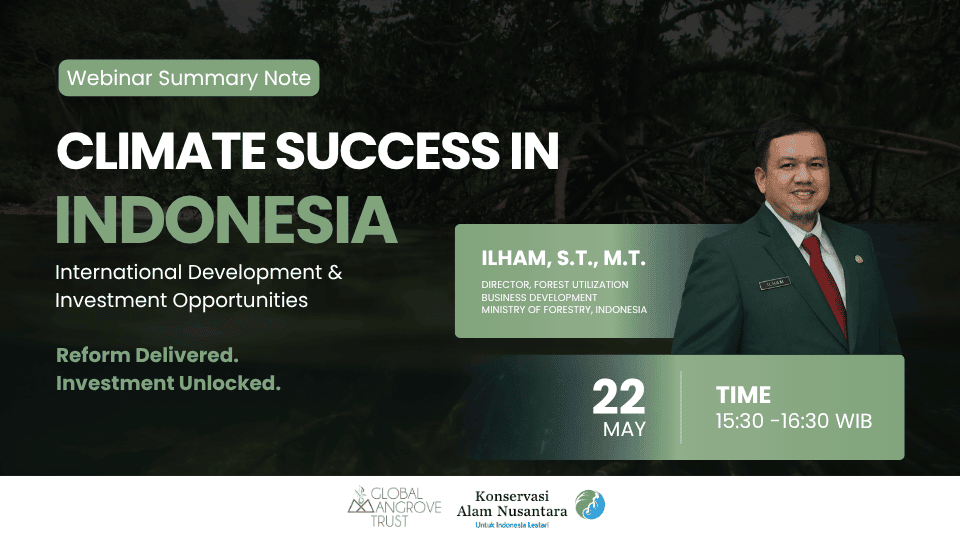
The keynote session was delivered by Mr. Ilham, Director of Forest Utilization Business Development at the Ministry of Forestry Indonesia, who provided a detailed overview of Indonesia’s current carbon market direction, regulatory development, and long-term climate financing strategy.
Climate Financing Gap & Market Expansion
A major focus of the presentation centered around Indonesia’s climate financing gap and the growing role carbon markets are expected to play in closing it. Mr. Ilham explained that Indonesia requires approximately USD 757.6 billion in climate financing by 2035 to meet its Enhanced and Second Nationally Determined Contribution (NDC) commitments. In comparison, Indonesia’s average annual government climate expenditure between 2016–2024 stood at approximately USD 4.4 billion per year, representing only around 3% of the national budget.
He emphasized that Indonesia cannot rely solely on public financing to achieve its climate ambitions and must therefore expand alternative financing mechanisms, including carbon markets, blended finance structures, private investment participation, and international climate partnerships.
Indonesia’s Long-Term Climate Targets
The presentation also highlighted several major long-term government commitments announced beyond the second NDC period, including:
- 12 million hectares targeted for carbon removal and degraded land restoration
- 50 million hectares targeted for carbon reduction activities
- 8.3 million hectares linked to social forestry expansion
- 1.4 million hectares associated with customary forest recognition and management
Mr. Ilham noted that these targets represent large-scale opportunities for collaboration between government institutions, local communities, project developers, and international financing partners.
International Trading & Article 6 Pathways
Several important clarifications were provided regarding international market participation. Mr. Ilham explained that Indonesia is increasingly positioning itself to participate within international carbon markets and Article 6 cooperation mechanisms. Recent policy developments and Presidential Regulation No. 110/2025 are intended to create pathways for international carbon trading while balancing national climate objectives with economic growth considerations.
The session also clarified that Indonesia now allows Non-SPE voluntary carbon market transactions without corresponding adjustment mechanisms under the new ministerial framework, creating additional flexibility for voluntary market participation.
Carbon Trading Prior to Full NDC Achievement
One of the most notable operational clarifications during the session was that carbon market activities may proceed without waiting for Indonesia to fully achieve its NDC targets.
Mr. Ilham explained that under Presidential Regulation No. 110/2025, carbon trading may already proceed through carbon exchanges and direct trading mechanisms while Indonesia continues progressing toward broader national climate commitments.
Forestry & Non-Forestry Business Pathways
The presentation also outlined the general business process for carbon activities within forestry and non-forestry areas.
For forestry areas, business permits fall under the Ministry of Forestry, while carbon trading approvals and recommendations are currently issued free of charge by the Ministry. Forestry area non-tax state revenue (PNBP) fees were presented at a maximum of approximately IDR 5,000 per hectare.
For non-forestry areas, permitting pathways may involve provincial governments, the Ministry of Land and Spatial Planning (ATR/BPN), or the Ministry of Marine Affairs and Fisheries depending on project classification and location.
Eligibility for Forestry Carbon Projects
A significant portion of the session focused on project eligibility and institutional structuring. Mr. Ilham outlined that eligible actors may include forest utilization permit holders, social forestry scheme holders, customary forest communities, communal forest holders, and environmental service utilization permit holders for carbon activities. Eligible project areas may include production forests, protected forests, customary forests, communal forests, and certain non-forest areas.
He also clarified that international organizations may continue participating through partnerships with Indonesian entities, particularly for forestry-related activities requiring local institutional arrangements and permits.
Validation & Verification Pathways
One of the most important operational clarifications related to validation and verification procedures. Mr. Ilham explained that the Ministry of Forestry does not intend to duplicate international validation and verification processes where projects have already been assessed by nationally or internationally accredited Validation and Verification Bodies (VVBs).
Instead, Ministry review will focus primarily on documentation completeness and legal compliance considerations while maintaining oversight through Indonesia’s regulatory systems. This was presented as an effort to reduce unnecessary duplication and improve implementation efficiency.
Safeguards, FPIC & Community Participation
Projects seeking approval are expected to demonstrate meaningful community involvement, benefit-sharing arrangements, biodiversity safeguards, reversal-risk management, and FPIC (Free, Prior, and Informed Consent) principles. The presentation emphasized that social forestry and community-based forest management are expected to become central components of Indonesia’s future carbon market ecosystem, ensuring that climate finance mechanisms also generate social and economic co-benefits for local and indigenous communities.
The regulatory direction presented during the session also reinforced Indonesia’s intention to strengthen environmental integrity, governance quality, and long-term accountability within the forestry carbon sector.
Transitional Arrangements for Existing Pipeline Projects
Mr. Ilham also clarified that Indonesia’s carbon market framework includes a Non-Tax State Revenue (PNBP) mechanism applicable to carbon trading activities. Under the current framework, a 10% non-tax revenue charge is applied to the first transaction within carbon trading activities. This mechanism forms part of the government’s downstream market regulation approach, while approvals and recommendations for forestry carbon trading projects issued by the Ministry of Forestry remain free of charge. The discussion further clarified that this transaction-based charge is separate from forestry permit-related fees and forms part of Indonesia’s broader carbon market governance structure.
Market Development & Economic Positioning
Mr. Ilham also highlighted several broader economic and policy objectives associated with Indonesia’s emerging carbon market framework.
The new ministerial direction is intended to:
- expand compatibility with international standards and Article 6 mechanisms,
- strengthen financing opportunities for restoration and conservation,
- improve governance and business process efficiency,
- support community and indigenous participation,
- generate employment opportunities within forest landscapes,
- and position Indonesia’s forests, peatlands, and mangroves as globally significant natural capital assets within future climate-finance markets.
Carbon Trading Revenue Mechanism
Mr. Ilham also clarified that Indonesia’s carbon market framework includes a Non-Tax State Revenue (PNBP) mechanism applicable to carbon trading activities. Under the current framework, a 10% non-tax revenue charge is applied to the first carbon credit transaction. This mechanism forms part of the government’s downstream market regulation approach, while approvals and recommendations for forestry carbon trading projects issued by the Ministry of Forestry remain free of charge. The discussion further clarified that this transaction-based charge is separate from forestry permit-related fees and is intended as part of Indonesia’s broader carbon market governance structure.
Monitoring, Transparency & Long-Term Direction
During the Q&A session, additional discussion focused on monitoring systems, transparency frameworks, and the government’s ongoing efforts to strengthen digital registry and project monitoring systems for improved oversight and implementation visibility.
Overall, the session provided practical insight into how Indonesia is positioning itself within international carbon markets while simultaneously strengthening domestic regulatory structures, community participation frameworks, and long-term implementation oversight.
Looking Ahead
The webinar reinforced the importance of continued dialogue between governments, communities, project developers, and international stakeholders as Indonesia continues refining its carbon market architecture and expanding pathways for community-led climate action. Global Mangrove Trust extends its sincere appreciation to the Ministry of Forestry Indonesia, Mr. Ilham and his team, YKAN, and all participants who joined the session.