
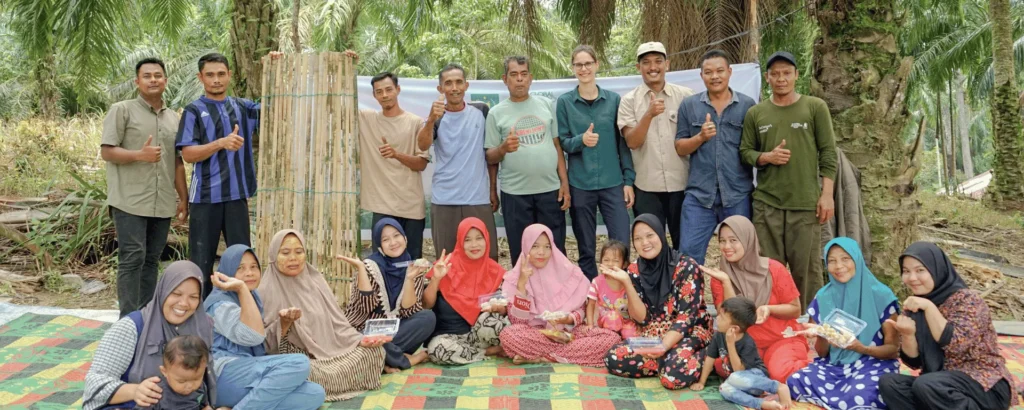
Over the past year, GearBank has transitioned from a community-driven pilot into a more structured livelihood programme supporting coastal communities in North Sumatra. Initially developed through workshops in 2024 that identified the need for viable alternatives to mangrove logging, the programme now provides practical income pathways for both men and women through small-scale fisheries and seafood processing.
Since its launch in January 2025, GearBank has expanded across four villages: Pulau Kampai, Pangkalan Siata, Halaban, and Salahaji. The programme currently engages 126 men organised into twelve fishing groups and 42 women across four processing groups. What began as a pilot is now operating as a decentralised system, with communities managing day-to-day activities independently while field teams focus on monitoring and technical support.


Transition to Alternative Livelihoods
A key milestone has been the shift away from mangrove logging. Participating men are now engaged in crab fishing using bubu traps and shared nets. This transition has resulted in more stable and safer work. Average daily income has increased from approximately 50,000 IDR to around 60,000 IDR per day, while also removing the risks associated with illegal logging activities. An important indicator of programme stability is reinvestment. Many participants have begun upgrading their equipment for example, replacing traditional bamboo traps with more durable stainless steel alternatives. This reflects both improved income security and growing ownership over the livelihood model.
Women’s Participation and Early Income Generation
Women’s groups, while at an earlier stage, have begun generating income through small-scale seafood processing. Across the four villages, groups are producing dim sum, fish balls, and salted fish, with sales already taking place within local markets including schools, government offices, and nearby households. Income levels remain modest but represent a meaningful shift. In Halaban, for example, one group generated approximately 630,000 IDR over a quarter, shared among members. While still early, this marks a transition from zero income to active participation in the local economy. Production is currently aligned with local demand, with no significant unsold inventory.


Strengthening the Value Chain
Building on these early outcomes, GearBank is now supporting a shift toward shelf-stable seafood products. Fresh products have limited market reach due to storage and transport constraints, particularly in areas with unreliable electricity. Shelf-stable products are being developed to enable access to larger urban markets such as Medan, where purchasing power is significantly higher. This next phase will focus on expanding market access through partner shops and online channels, alongside improvements in packaging, certification, and product standardisation. Capacity building has remained central to the programme. Initial training covered trap construction, crab handling, and seafood processing techniques. With these foundations in place, communities are now operating largely independently, marking a clear shift from implementation to community-led operations.
Looking Ahead
As GearBank moves forward, the focus remains on strengthening the full village-to-market value chain while maintaining sustainable resource use. By combining aquaculture skills, community enterprise, and market connectivity, the programme is gradually establishing a model that improves household incomes, expands economic opportunities for women, and reduces pressure on surrounding mangrove ecosystems.
